

Reimagining Housing
 16.06.2025
 5 minutes

What is your idea of social housing?
No doubt, the answers would vary. Some shaped by personal experience, others by perception or politics. For some, social housing may bring to mind large estates or apartment blocks. For others, it may represent opportunity, support, or even stigma. The truth is, housing – especially social housing, carries weight. And perhaps it’s time we started talking about it differently.
Across Malta and Gozo, five humble homes quietly challenge old ideas about social housing. These form part of the Housing Authority’s Specialised Housing portfolio and have ushered in an innovative approach to their design and management. They are not large-scale, nor do they tend to appear in headlines, yet they are intricately designed to offer tailored services to specific target groups, moving beyond a one-size-fits-all approach. Their impact is deeply personal.
In Bormla, Dar Tereża, managed by the Richmond Foundation, offers mothers experiencing mental health challenges a place to heal and parent with dignity. In Birgu, Dar Bla Ħitan, managed by Mid-Dlam Għad-Dawl Foundation, provides a halfway home for individuals leaving prison, giving them a chance to reintegrate into society in a safe, structured environment. In San Ġwann, Dar il-Qawsalla, managed by the Malta Gay Rights Movement (MGRM), offers a safe haven for homeless LGBTIQ individuals facing housing insecurity or family rejection.
Then there’s Carlo Gastini Residence in Valletta – Malta’s first intergenerational housing project – where elderly residents and young people live side by side, supporting one another in surprising and often heartwarming ways. “Proud octogenarians argue over who had the most helpful young neighbour,” said Housing Europe Secretary General Sorcha Edwards during her visit to this residence earlier this year. The project provides an innovative model that empowers independent and semi-independent living while addressing the evolving aspirations of how people want to live.
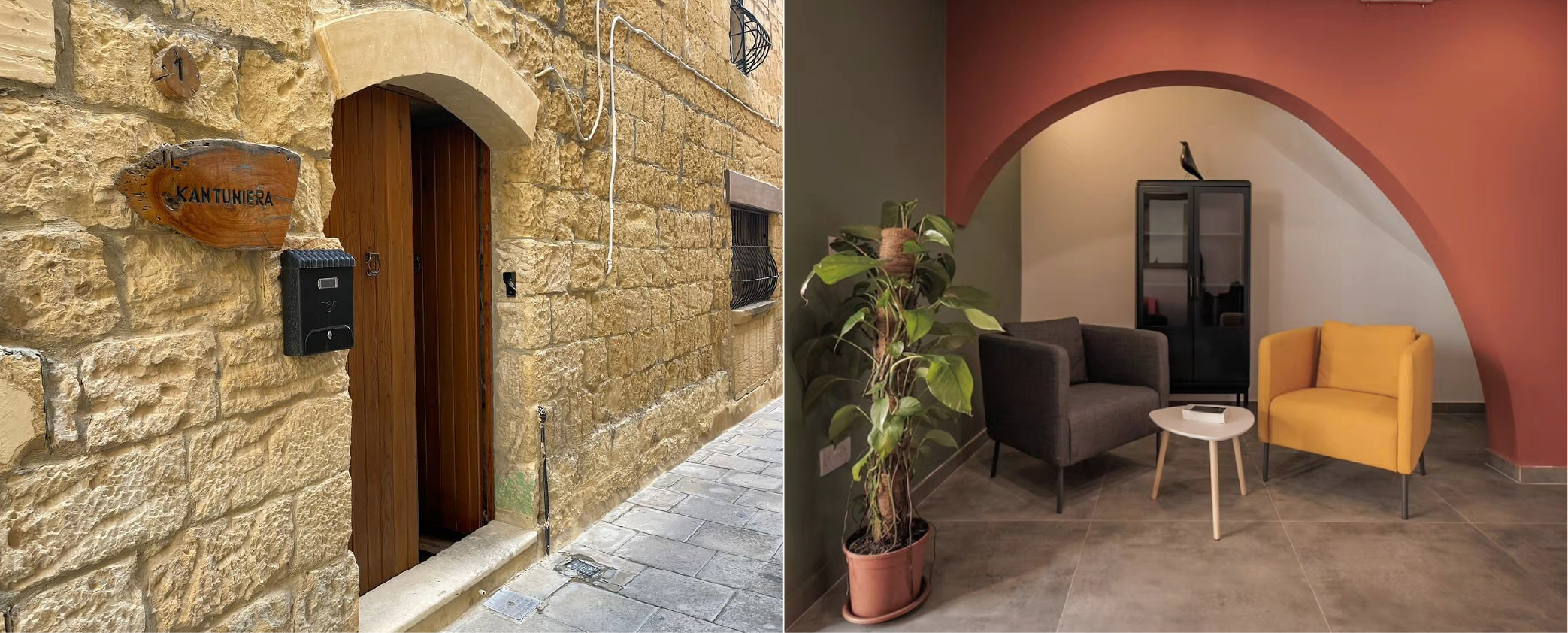
These projects are not limited to Malta. In Gozo, Dar il-Kantuniera offers a soft landing for individuals with mental health conditions transitioning back into the community. These projects are deeply embedded in our community’s social fabric. They are proof that by empowering NGOs and putting trust in local expertise, we can build spaces that respond to real needs and help communities grow stronger from within.
These homes did not begin as carefully crafted social spaces. Each was once a dilapidated property with immense, overlooked potential. In collaboration with local NGOs, each site was earmarked for a specific social mission. Through a national design competition organised by Kamra tal-Periti, the projects were brought to life with designs that are both functional and aesthetically considered. Architects were invited to propose solutions tailored to the specific needs of each target group. The selected designs are not only aesthetically pleasing, but are empathetic, inclusive, and pragmatic. Equally important was the strong involvement of different stakeholders, including at the community level.
This is the Malta Housing Authority’s quiet revolution: small-scale, specialised, human-focused housing. While it would be naïve to think these projects alone can solve all of Malta’s housing challenges, they demonstrate what is possible when we begin with empathy and design with care.
Reimagining housing is not about scale but about purpose. And in that purpose, we find the courage to build places where people belong and stable communities thrive.
.png)
.png)



.png)